Confessions by Saint Augustine
'Give me chastity and continence, but not just yet!'
Introduction
And yet for all of these titles and many more, Augustine himself was plagued by his own sins and faults before God. He credits none of these workings to his own ability but rather through Christ working in him. Most peculiar is his considerably late baptism, atypical for a well-renowned doctor of the Church. However, none of these facts about the man bring us any closer to the inner workings of his mind. Perhaps this is where his most widely publicised work (Confessions) can provide valuable insight.
 Following this section, Augustine engages in an exegetical reading of Genesis 1:1-2 where he discusses a symbolic and spiritual interpretation of these first two verses. The last section reads Genesis 1 in an allegorical fashion and explains how multiple explanations can be seen to be true from a singular reading of the text.
 However, an obvious and pertinent question lingers amid the potential reader's mind when Augustine is recommended to them: "Is this book a solely Christian book?" Does one have to be a faithful Christian in order to engage with this work? Truly there is a joy to reading Confessions that does not merely reveal itself to Christians. However, the recollections of a sinful man and his confirmation into faith are best appreciated and personally understood by those who have already come to faith. Confessions is a work intended upon conversion. Non-believers should perilously attempt the pages for fear of being convinced by his candid profession of faith and reverential fervour.
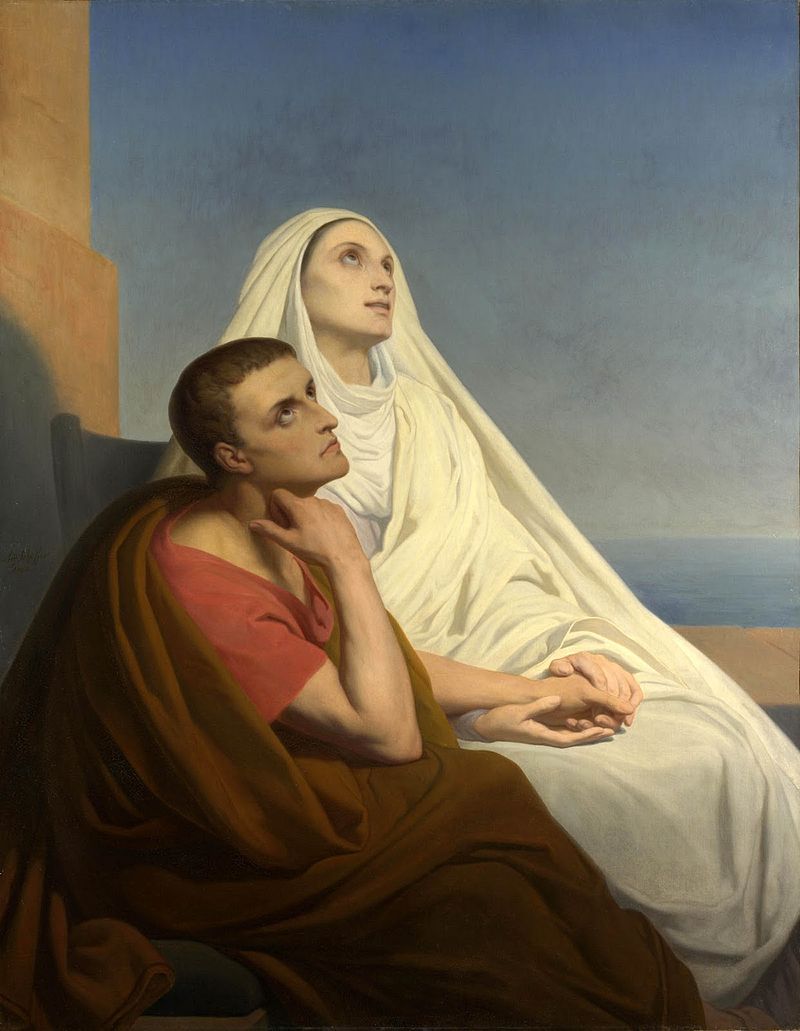 Augustine firmly defends Christian doctrine and the unity of the Catholic Church. It is through his example that we may reflect upon our own attitudes in regards to God and the Church. A key feature of his life is the way in which he interacted with others. The faithful members of his life prayed, worked, and attempted to convince Augustine of the Catholic truth. This is best exhibited in the patient faith of his mother: Saint Monica. Her continued prayer for her son's conversion reportedly never ceased. Neither did her love for her son diminish with the years of distant neglect. Similarly, her patience with God did not stumble due to her son's late conversion. Perhaps it is telling that she died shortly after Augustine's conversion and baptism thus fulfilling the prayers which had been left for so long unanswered.
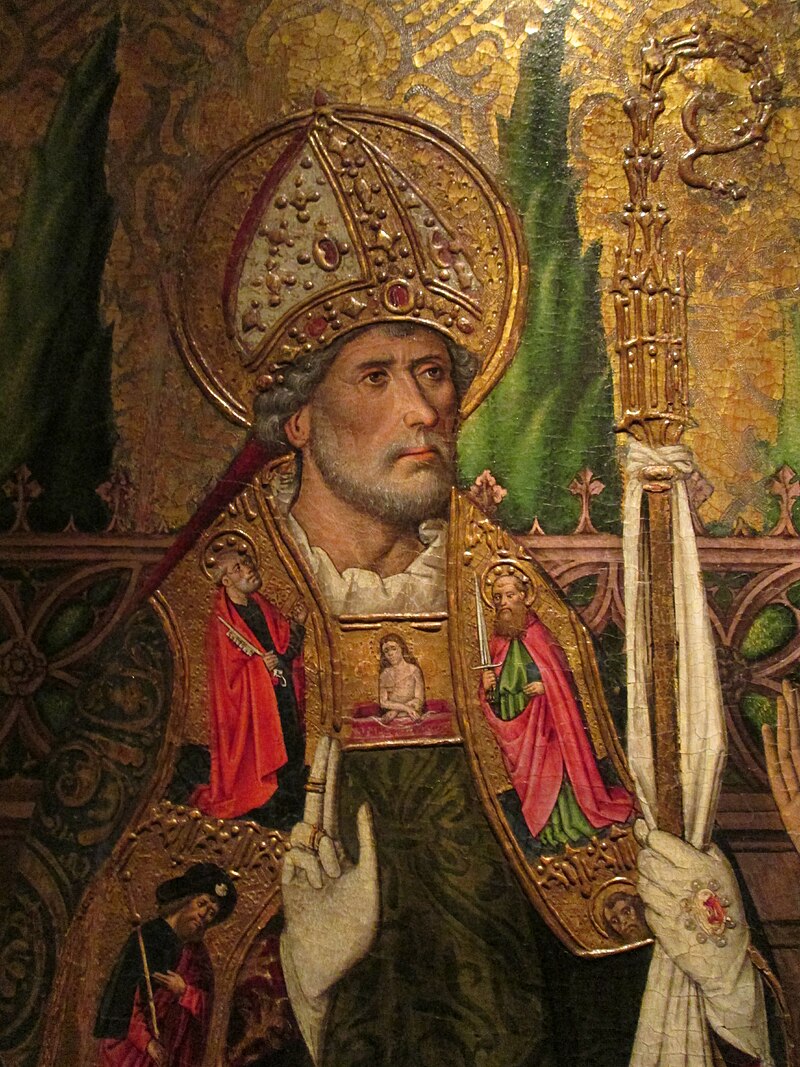
.jpg/800px-Museo_del_Duomo_-_Milan_-_St_Ambrose_of_Milan_-_Unknown_Lombard_author_(early_17_century).jpg) Another major figure involved with Saint Augustine's conversion was Saint Ambrose, Bishop of Milan at the time of Augustine's tutoring there. His patient and informed conversations with Augustine inform us of the way in which we must patiently endure the gradual and hopeful conversion of reluctant friends and family. How many of us have intelligent yet wayward relations that refuse to see the truth which we put before them? How can we convince them of the full sufficiency of Christ? Perhaps the patient prayers of Saint Monica and the patient conversations and scriptural explanations of Saint Ambrose are our guides?
Another major figure involved with Saint Augustine's conversion was Saint Ambrose, Bishop of Milan at the time of Augustine's tutoring there. His patient and informed conversations with Augustine inform us of the way in which we must patiently endure the gradual and hopeful conversion of reluctant friends and family. How many of us have intelligent yet wayward relations that refuse to see the truth which we put before them? How can we convince them of the full sufficiency of Christ? Perhaps the patient prayers of Saint Monica and the patient conversations and scriptural explanations of Saint Ambrose are our guides?
The Structure of Confessions
“The life of Saint Augustine has a special appeal because he was a great sinner who became a great saint, and greatness is all the more admirable if it is achieved against odds.”
Confessions is a work that is helpful to separate into parts but yet should be considered as a whole. From a cursory glance, the greater portion can be considered to be autobiographical. In this sense, Confessions is a unique and seminal work for its time, being that the work is considered to be the first Western Christian autobiography ever written. It is a spiritual self-reflection written at the cusp of the 5th century AD which details the many avenues of thought he found himself travelling down in his eventual return to the Lord.
“For what am I to myself without You, but a guide to my own downfall?”While a breakdown of the separate sections of Confessions is helpful for our understanding of the text, it is vitally important that we understand that the entirety of the work is a “confession”. Even his theological and philosophical discussions on experience and faith are ultimately a confession in which Augustine desires to admit his professions before God. His thoughts, his questions, and his admissions are all offered up to God in reverence and humility.
Similarly, the autobiographical portion does not shy from considered theological exposition. Therefore the work of thirteen compiled books is not to be read as a dissection of the severed limbs but rather vivisection of the holistic body.
Augustine's Legacy - Why Should You Read Confessions?
“Tolle, lege: take up and read.”
For many, this work should enter into the finest literary works of the Western tradition. Truly, anybody can derive value from this collection of books and be challenged and intrigued by its broad scope and tireless explanation. Few books can be read so painfully and so intimately as Confessions.
“Late have I loved you, beauty so old and so new: late have I loved you.”
It would be dishonest not to highlight the unique perspective Confessions can provide to members of secular fields and studies. For those interested in the history of autobiographical works it should be mentioned that it is the most complete record of any single person from the 4th and 5th centuries AD. Similarly, for those interested in the Late Western Roman Empire and the philosophical climate therein, it hosts a discussion over many sects and cults from the era. Augustine's personal experience in the Manichaeans (of whom very little written material remains today) and the Neoplatonic school are useful both for a Catholic's understanding of the faith and for secular historians researching these non-Christian cults.
 A Christian Book, A Catholic Book
Wherever the Christian is in his walk with the faith, Confessions tells a familiar yet unfamiliar tale within its pages. The deep sorrow aroused from a humbled sinner is all too recognisable for us but yet we walk a fundamentally different path to Augustine in each of our own personal journeys. We may not have joined a questionably "Christian" cult or have been a fine teacher of rhetoric throughout the Roman Empire. Yet his personal and painful cries and supplications are relatable to all of us in our walk with Christ.
“Too late came I to love you, O Beauty both so ancient and so new! Too late came I to love you - and behold you were with me all the time . . .”
“How high a price we pay for the burden of habit! I am fitted for life here where I do not want to be, I want to live there but am unfit for it, and on both counts I am miserable.”
“Your best servant is the person who does not attend so much to hearing what he himself wants as to willing what he has heard from you.”
Augustine provides the longing follower with hope also. Those who desire God with their hearts and yet cannot hear His call may find comfort in the pages of Confessions. His late conversion and baptism remind us that it is truly never too late for God to discover us and conform us to His will. Similarly, to engage with scripture with such learned fervour and profound understanding proves to us that it is the Lord's work in us and not the sufficiency of our own faculties that make us worthy of knowing Him. One can be sharply confronted by the sheer volume and regularity of scriptural references throughout the work: a testament to God's illuminating wisdom upon those of us at any stage in our lives. You may wonder how a man who came so late to Christ would then have such a broad and deep knowledge of scripture. Perhaps this is a test for all of us, that we simply do not have the same reverence for God's word as Saint Augustine did and should therefore amend our ignorance with reading.
Understanding Genesis
However, Augustine does not shy away from interpreting the first chapter of Genesis (it should be noted that Saint Augustine would not have had chapter or verse numbers present within his scriptural texts as these were a later development within the Church's history) and puts particular attention to the first two verses of the first chapter.

Print and Publishing Quality
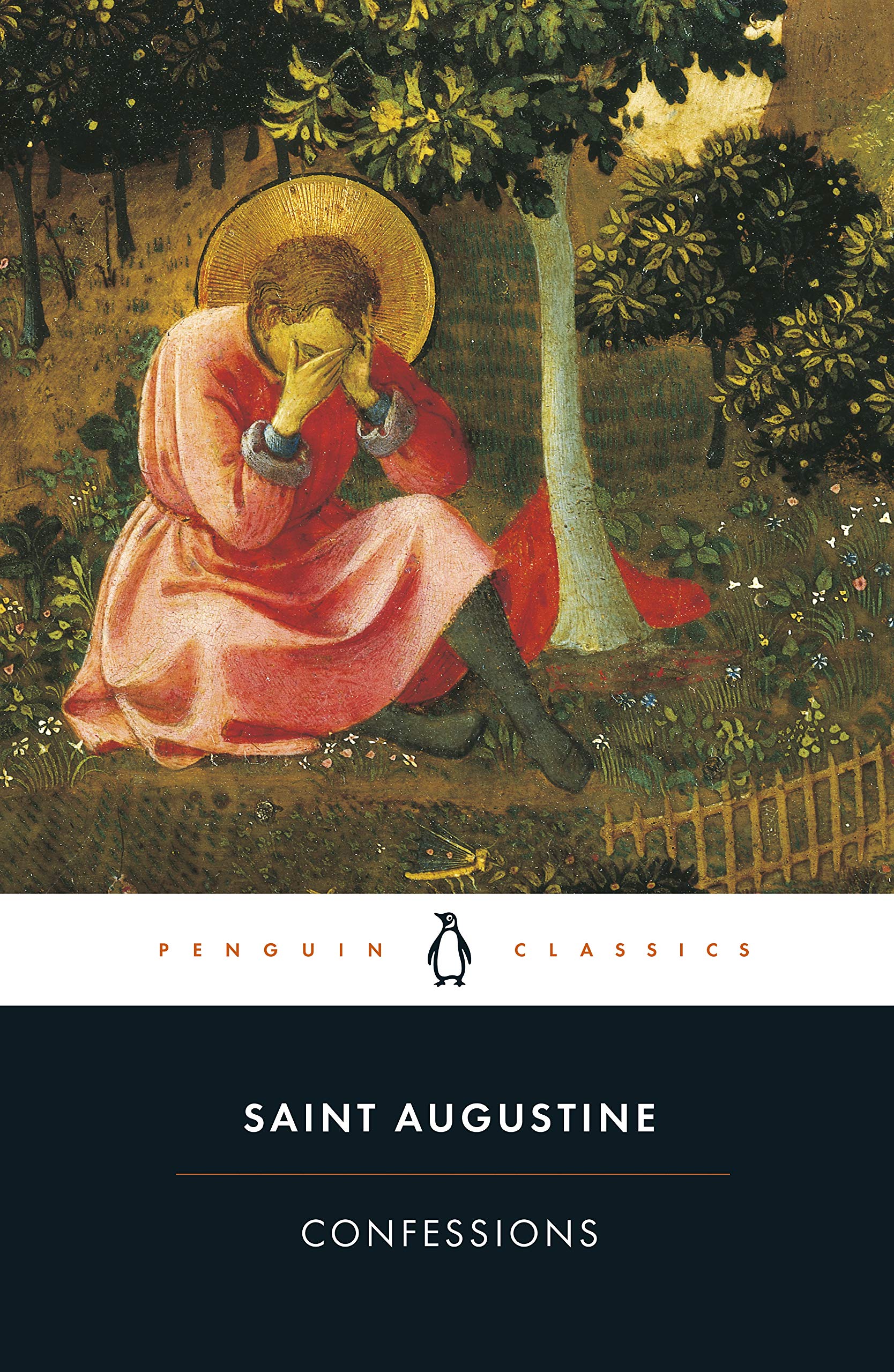
This edition of Confessions was published in the Penguin Classics range. The book is well-produced and easy to read. The editing is brilliant and adds the necessary citations throughout the work for us to turn back to the original text and fully understand Augustine's intentions. The book was well priced and is a perfect size and length for anyone looking for a casual read.
Conclusion
“Late have I loved you, beauty so old and so new: late have I loved you.”
For the sake of brevity, I shall not continue to praise Saint Augustine or his work Confessions. Truly its notoriety speaks for itself and the work is well known upon the ears of the Church. Confessions is the perfect guide to understanding Augustine's life, and it similarly serves as a template for one's journey into faith. Few of us will live a similar life to Augustine, but his ideas and recollections are familiar to us all. I highly recommend reading this book if you are new to the faith, but that does not mean an experienced Christian cannot be challenged by its pages to follow Christ more substantively than they already are. A truly incomparable work!
Comments
Post a Comment